
Rethinking the MLB Playoffs
Major League Baseball has had problems with the playoffs. Despite recent changes raising the playoffs to 10 teams with two one game wildcard eliminations, the changes have not been enough. Teams expecting to lose will intentionally start a rebuild, reducing the excitement of the league. Others trade their stars for prospects in the second half, which boosts teams that are already good. “Seller” teams directly affect revenue and viewership as well, as the teams putting forth little effort to win consistently have the lowest attendance and/or TV ratings. If the MLB changed their playoff structure, some of these issues could be reduced.
An updated playoff model will increase attendance for teams previously not expecting to make the playoffs. Currently, of the four teams with the lowest attendance, the Kansas City Royals, Miami Marlins, and Baltimore Orioles are also in last place of their respective divisions (the Tampa Bay Rays make no effort to relocate). To look at a larger trend, take the Houston Astros from 2013 through 2018 compared to the Baltimore Orioles during the same time period. In 2013, Houston had the worst record in baseball, and finished 27th in attendance. The Orioles on the other hand, moved from 18th in 2013, to 13th in attendance as they won their division in 2014. However, from 2014 through 2018, the Orioles have progressively done worse and worse, finishing 2018 with a 47-115 record and ranked 26th in attendance. The Astros, doing almost the exact opposite of the Orioles, went from the worst record in 2013, to winning 103 games in 2018 and ranking 8th in attendance. Furthermore, the Astros made the playoffs in 2017 and 2018, the Orioles did in 2014 and 2016. Fans clearly want competitive games and teams, and with some changes to the playoffs, the MLB can create a larger number of meaningful games for more teams.
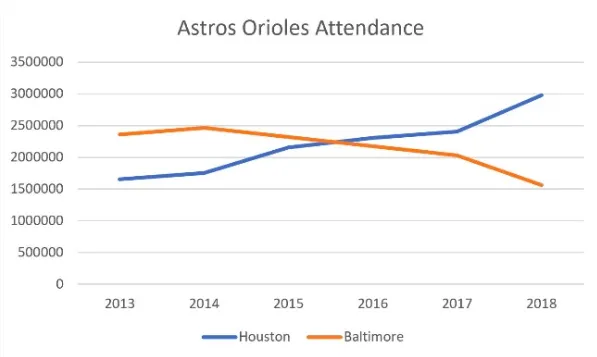
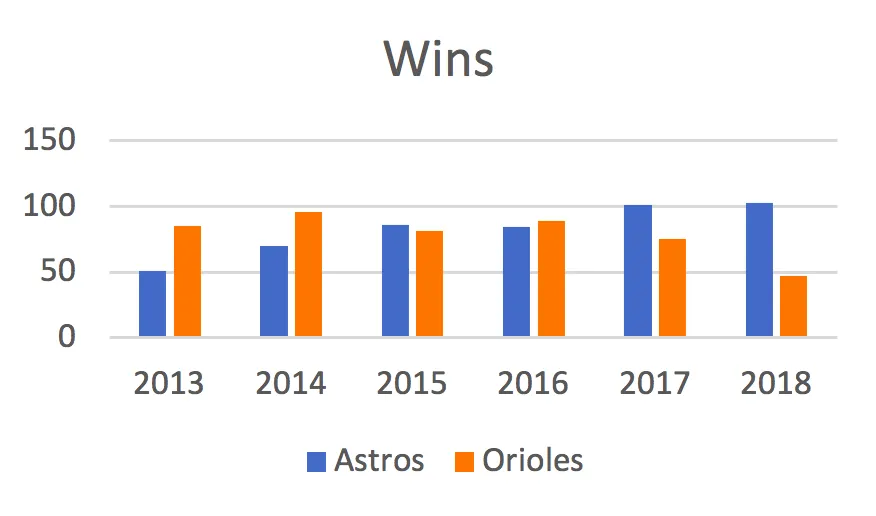
While you can’t create more wins for every team, you can increase their competitiveness, which is essentially what the wins and attendance relationship is representing above. In order to increase competitiveness across the league the playoff structure needs to be overhauled. Consider a new playoff model where 18 teams would reach the playoffs, 3 from each division. That would nearly double the number of teams getting in. However, having a 1 seed play the 9 seed doesn’t make sense. The lower seed should have to play through more elimination rounds than the top seed.
Both AL and NL would be seeded 1-9. Each round, one elimination series will occur between the two lowest seeds in each league (no inter-league play until the WS). The remaining seeds will play their next closest seed, i.e. if 9 and 8 are playing the elimination game, 7v6, 5v4, 3v2 and 1 has a bye on odd rounds. The results of each round will determine the seeding in the next round. Eventually it will work down to 4 teams in each league, where playoffs will be conducted the same way the Division, League and World Series occur now. This playoff design is not meant to necessarily increase the odds of lower seeded teams being successful in the playoffs, but to give more teams a chance to make a run. I believe the best teams will still see the most success in the playoffs, but the chance to see an underdog have success will build excitement across the league. See the bracket below for a more complete breakdown of how this playoff model would work.

I believe this playoff change would rejuvenate the fanbase. To get to the quarterfinals, there would be at least 5 and up to 10 elimination games. Viewership of elimination games would bring in more revenue. The MLB will generate television, ad, and ticket sales through teams that would otherwise be non-contenders. This style also promotes teams continuously competing instead of becoming sellers at the trade deadline.
What are the concerns? First, the bracket may not be perfect. If the one seed continuously wins out, they’ll play as many as 9 less games than a 9 seed. Is that a fair reward for winning out? Second, the regular season would have to be shortened to accommodate the longer playoffs. This shouldn’t be an issue because the bottom 12 teams at the end of the season rarely get any attention. Scheduling will be difficult to manage with travel between teams having to occur quickly. Managers will have challenges deciding when to use certain pitchers throughout the playoffs. However, watching those pitching decisions could be thrilling.
This playoff proposal is not intended to be the final say. The goal is to spark ideas and create a conversation among the fans, so we can continue to improve our sport. What are your thoughts, questions, comments or concerns? Shoot me a message on twitter @hayjoe93.